


In professional audio and video networking, AVoIP has become an increasingly common system architecture.
Once a project moves into the design stage, the challenge is no longer simply to “transport” audio and video. The real task is to keep multiple types of traffic—including audio (A), video (V), control (C), and lighting (L)—running reliably on the same network.
These services have very different requirements for bandwidth, latency, multicast, and clock synchronization. When heterogeneous traffic converges on one network, bandwidth contention, multicast flooding, timing conflicts, and other issues can quickly emerge.
Depending on project scale, budget, and the desired level of convergence, AVoIP network design can generally be understood through three architectural approaches.
Level 1 Convergence: Physically Separated Networks
The most basic approach is to keep different service types completely separated.
Audio, video, control, and lighting are each assigned dedicated access switches and transmission links. The traffic remains isolated and is ultimately aggregated at the core switch.
The advantages are straightforward:
• Complete service isolation: different traffic types do not compete for bandwidth;
• Simple access-layer logic: switch configuration and troubleshooting remain relatively straightforward;
• High network stability: one service has limited impact on another.
The trade-off is equally clear.
Each service requires its own devices and links, increasing the number of switches, cabling runs, and core-switch ports. As the project grows, hardware redundancy becomes increasingly significant.
This architecture is therefore better suited to projects with relatively generous budgets, clearly separated service domains, and a strong emphasis on network stability.
Level 2 Convergence: Converged Access with Layered Uplinks
To reduce the number of front-end devices, the network can move to a higher level of convergence.
In the second architecture, audio, video, control, and lighting no longer use separate access switches. Instead, they connect to the same floor or zone access switch.
However, each service still retains a dedicated uplink. In other words, the access layer is converged, but audio, video, control, and other traffic still travel over separate uplinks from the access switch to the core, where they are centrally handled.
This design achieves a practical balance between device count and network stability:
• A highly integrated access layer reduces the number of front-end switches;
• Separate uplinks maintain a degree of isolation between service types;
• Performance requirements on access switches are comparatively lower.
The limitation is that uplink count rises rapidly as more access switches are added.
For example, if each access switch uses separate uplinks for video, audio, and control, ten access switches may require a large number of core ports and uplinks. Network complexity is therefore shifted toward the core layer.
This makes the architecture a compromise between stability, device count, and overall deployment cost.
Level 3 Convergence: Fully Converged Single-Link Networking
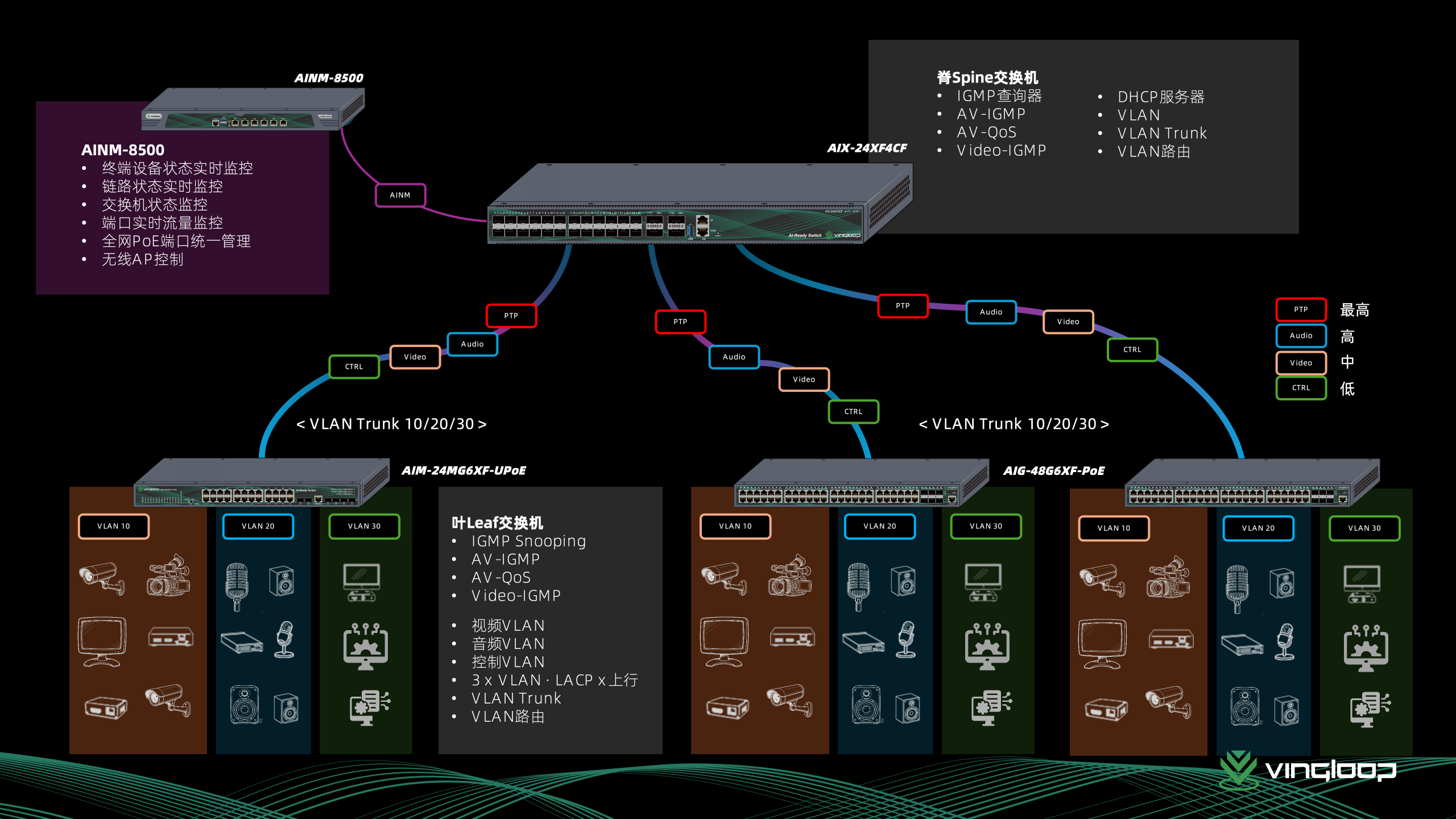
The next step is full convergence: audio, video, control, and other traffic are consolidated onto the same uplink, subnet, and VLAN, creating a truly converged AVoIP network.
Compared with the first two approaches, this design can significantly reduce dedicated links and duplicated hardware, resulting in a much cleaner overall architecture.
Yet the “simpler” the network appears, the more capable the switching infrastructure must be.
The reason is that each service has very different transmission characteristics:
• PTP clock synchronization is highly sensitive to timing;
• Professional audio requires low latency and stable delivery;
• Video demands sustained high bandwidth;
• Control traffic is lighter, but still requires reliable response.
When all of these traffic types share the same link, the network needs finer-grained traffic identification, scheduling, and multicast management. Otherwise, latency, packet loss, congestion, and timing errors may occur.
This is also one of the key distinctions between professional AV switching networks and conventional data networks. In a fully converged architecture, VINGLOOP switches can apply targeted network optimization for different service types:
• Video multicast optimization: supports large-scale concurrent video-stream transmission;
• AV-QoS: assigns forwarding priorities by service importance, with PTP clock synchronization at the highest priority, followed by audio and video, and then control traffic, helping protect critical AV services;
• Intelligent auto-optimization: dynamically adapts traffic handling according to network load;
• AV-LACP uplink bonding: supports single-link, active-active, HA redundant, and other deployment modes, while allowing flexible expansion across multiple uplinks.
From the access layer to the Spine core, the network is no longer responsible only for forwarding packets; it must also coordinate and schedule different AV services as a unified system.
Which Architecture Should You Choose?
There is no single “best” network architecture.
Instead, the three approaches represent a progressive increase in convergence:
Physically separated networks
More devices and links are used in exchange for simple, clear service isolation, making this approach suitable for high-budget projects with conservative reliability requirements.
Converged access with layered uplinks
The number of front-end switches is reduced while service links remain independent, providing a compromise between stability and cost efficiency.
Fully converged single-link networking
A more technically demanding architecture achieves a highly streamlined design and efficient transport, and represents a key direction for modern high-end AVoIP systems.
In real projects, there is no need to pursue the highest possible level of convergence simply for its own sake. A better approach is to select the architecture according to service scale, budget, reliability requirements, operational capabilities, and future expansion needs, balancing stability, cost, and system complexity.
As AVoIP systems evolve from physically separated networks toward deeper convergence, the role of the switch expands from basic connectivity to multicast management, service scheduling, link management, and network visualization. Enabling complex AV traffic to coexist reliably on a single network is one of the core challenges that professional AV network design must continue to address.